




The story of Aladdin comes from or The 1,001 Nights, a collection of traditional stories from the Middle East.
In the story, a young boy is approached by a man who claims to be his uncle. Actually a powerful magician, the supposed uncle leads Aladdin to a cave containing a magic lamp. He tries to trick Aladdin into giving him the lamp, but Aladdin resists and keeps the lamp.
He accidentally calls forth the genie of the lamp and gets three wishes. He determines to marry the daughter of the sultan, and with the help of his mother and the genie, does so. The genie makes a wonderful palace for Aladdin and his bride. However, the magician turns up again and tricks the princess into giving him the magic lamp, and magically transports the palace to a wilderness while Aladdin is away.
Aladdin finds the princess through further magic and gets back the lamp, and after another couple of adventures which tend to get left out of most retellings, he gets rid of the evil magician. He and his bride live happily ever after.
You can read the story online. Listen to it at Storynory.
It’s also available in collections of the tales from The Arabian Nights.
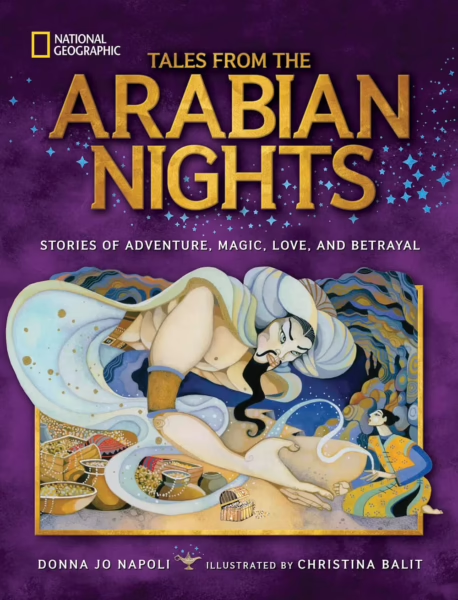
Mary Engelbreit included this story in her Nursery and Fairy Tales Collection.

There is a reissue of the classic story illustrated by John Hassall, and a bilingual version in Spanish and English. Aladdin and the Wonderful Lamp has the gorgeous illustrations of Edmund Dulac.

Philip Pullman has done a new retelling.

The Disney version will be the most familiar to most of our students, and there is a Step Into Reading version with the Disney illustrations as well as a picture book.

Curriculum connections

English
As you read the story, and especially if you read multiple versions and perhaps watch the movie as well, you will find that the story is long and disorganized. The magic lamp, which sends out a genie when people rub it, the tricky magician who gets the princess to trade her old lamp for a new one with the catchy slogan “New lamps for old!” and the three wishes are just about the only elements of the story that are always found in it.
This can easily happen with folktales. Often they are told and retold for generations, with each storyteller adding their own flair, forgetting details, and changing the story to please themself and their audience. Easy-to-remember parts, like a slogan or rhyme, and common folktale elements like the three wishes are often carried forward even as the story changes.
French archaeologist Antoine Galland collected and translated the stories in The Arabian Nights, just as the Brothers Grimm collected German folktales. The story of Aladdin was told to him by Hanna Diyab, a Syrian Storyteller. France was given control of Syria after World War I, when the Ottoman Empire, which occupied it until that time, was defeated. France controlled Syria from 1916 till they achieved independence in 1946.
In the original story, Aladdin’s bride creates problems with the genie. If you read the story with that element, compare it with two other folktales: The Fisherman and His Wife and The Three Wishes. The three stories come from different times and places, but all three involve wishes and a wife who creates problems with those wishes. Have students write about the three wishes they would make if they had magical wishes. For more advanced classes, have them write a story in which they have three wishes but things don’t work out well.
Social Studies
As it happens, Aladdin, along with Ali Baba and the 40 Thieves and Sinbad the Sailor, was added to the 1,001 Nights when a French translation was published in 1704. The story was originally set in China and the magician came from Africa. There is nothing in the story that connects with China or Africa. Probably very few people in France in 1704 had ever visited or learned much about either China or Africa, and this probably includes the translator of the book, Antoine Galland. China and Africa were probably just thrown in to serve as exotic locations.
However, the story is now usually told as though it were set in an Arab or Persian country. Ajam has some well-supported speculations about how this might have happened. Author Prateek Dasgupta suggests that a Syrian immigrant was inspired by Versailles. See a slideshow of some of our photos of the French palace of Versailles below.
It may have been a traditional story from Syria, which is an Arab country in the Middle East. Virtually visit a palace in Syria, the Al Azem Palace, which was built by the Ottomans.
Google Arts and Culture offers a virtual visit to the Forbidden City, an ancient Chinese palace. These resources allow you to see palaces in China, the original setting of the story, Syria, the home of the storyteller who shared the folktale, and France, where the story was originally published.
Challenge students to think about how the story would be different if it were set in China (East Asia), in Syria (the Middle East), or France (Europe). Ask them to create an illustration of a scene from the story in one of these three places, using inspiration and information from the three palaces listed above. Have students research what these places were like in the 1700s and be prepared to provide references to defend the visual choices they make in their illustrations.
Reading Is Fundamental has an Aladdin lesson which sets the story in Morocco. This could be the starting point for a study of this North African nation.
Science
The enchanted lamp is an essential part of the story. This was an oil lamp. Nowadays, almost all of us use electric lamps, but before electricity lamps were fueled by oils of many different kinds. Oil lamps have been found in prehistoric archaeological sites. Oil lamps were used in Mesopotamia and Ancient Rome.
Explore some of the common lamp fuels of the past:
- Paraffin
- Kerosene
- Whale oil
- Olive oil
- Sesame oil
- Beeswax
We don’t have a source for whale oil, but you can read about any of the others at their links, and maybe try a few either as few or in cooking — with careful adult supervision, of course. You can also just write the names of the oils on index cards.
Sort the cards into animal, vegetable, and mineral sources of oil. (Paraffin and kerosene are both made from petroleum, so they are mineral oils. Whale oil and beeswax are produced by animals. Olive and sesame oils are vegetables oils.)
People used the kinds of oil available to them in the places where they lived. See if you can discover what kind of lamp oil was commonly used where you are. In Arkansas, where we live, bear grease (the fat of bears) was at one time used for fuel.
Now we use electric lamps, but electricity is often produced by burning fuel, just as oil lamps produced light by burning fuel. See if you can discover how electricity is made where you live. Possibilities:
- hydroelectric power
- wind power
- nuclear power
- solar power
- coal
- petroleum
- natural gas
Almost all modern fuels are mineral fuels. The distinction among modern sources of power is not animal, vegetable, or mineral, but renewable or fossil fuels. Write the modern fuel sources above on index cards and add them to the pile of fuel oils. Now, sort them into renewable and fossil fuels. (Renewable energy sources include all the animal and plant sources, hydroelectric, wind, and solar. While whale oil is theoretically renewable, its production would be illegal.)
Aladdin’s lamp was genie-powered, but the type of fuel used for a lamp of this kind would depend on the location of the story.
Create a bulletin board showing what you learn about the ways people of the past and present got light.
